

- 如何创建测试数据集
- 如何在这些数据集上运行您的 RAG 应用
- 如何使用不同的评估指标来衡量应用的性能
概述
典型的 RAG 评估工作流程包含三个主要步骤:- 创建一个包含问题及其预期答案的数据集
- 在这些问题上运行您的 RAG 应用
-
使用评估器来衡量应用的表现,考察以下因素:
- 答案相关性
- 答案准确性
- 检索质量
设置
环境
首先,让我们设置环境变量:import os
os.environ["LANGSMITH_TRACING"] = "true"
os.environ["LANGSMITH_API_KEY"] = "YOUR LANGSMITH API KEY"
os.environ["OPENAI_API_KEY"] = "YOUR OPENAI API KEY"
process.env.LANGSMITH_TRACING = "true";
process.env.LANGSMITH_API_KEY = "YOUR LANGSMITH API KEY";
process.env.OPENAI_API_KEY = "YOUR OPENAI API KEY";
pip install -U langsmith langchain[openai] langchain-community
yarn add langsmith langchain @langchain/community @langchain/openai
应用
虽然本教程使用 LangChain,但此处演示的评估技术和 LangSmith 功能适用于任何框架。请随意使用您偏好的工具和库。
- 索引:将 Lilian Weng 的几篇博客文章分块并索引到向量存储中
- 检索:根据用户问题检索这些分块
- 生成:将问题和检索到的文档传递给 LLM。
索引和检索
首先,让我们加载我们想要为其构建聊天机器人的博客文章并进行索引。from langchain_community.document_loaders import WebBaseLoader
from langchain_core.vectorstores import InMemoryVectorStore
from langchain_openai import OpenAIEmbeddings
from langchain_text_splitters import RecursiveCharacterTextSplitter
# 要从中加载文档的 URL 列表
urls = [
"https://lilianweng.github.io/posts/2023-06-23-agent/",
"https://lilianweng.github.io/posts/2023-03-15-prompt-engineering/",
"https://lilianweng.github.io/posts/2023-10-25-adv-attack-llm/",
]
# 从 URL 加载文档
docs = [WebBaseLoader(url).load() for url in urls]
docs_list = [item for sublist in docs for item in sublist]
# 使用指定的块大小和重叠初始化文本分割器
text_splitter = RecursiveCharacterTextSplitter.from_tiktoken_encoder(
chunk_size=250, chunk_overlap=0
)
# 将文档分割成块
doc_splits = text_splitter.split_documents(docs_list)
# 使用 OpenAIEmbeddings 将文档块添加到“向量存储”
vectorstore = InMemoryVectorStore.from_documents(
documents=doc_splits,
embedding=OpenAIEmbeddings(),
)
# 使用 langchain,我们可以轻松地将任何向量存储转换为检索组件:
retriever = vectorstore.as_retriever(k=6)
import { OpenAIEmbeddings } from "@langchain/openai";
import { MemoryVectorStore } from "@langchain/classic/vectorstores/memory";
import { BrowserbaseLoader } from "@langchain/community/document_loaders/web/browserbase";
import { RecursiveCharacterTextSplitter } from "@langchain/text_splitters";

// 要从中加载文档的 URL 列表
const urls = [
    "https://lilianweng.github.io/posts/2023-06-23-agent/",
    "https://lilianweng.github.io/posts/2023-03-15-prompt-engineering/",
    "https://lilianweng.github.io/posts/2023-10-25-adv-attack-llm/",
]

const loader = new BrowserbaseLoader(urls, {
    textContent: true,
});

const docs = await loader.load();

const splitter = new RecursiveCharacterTextSplitter({
    chunkSize: 1000, chunkOverlap: 200
});

const allSplits = await splitter.splitDocuments(docs);

const embeddings = new OpenAIEmbeddings({
    model: "text-embedding-3-large"
});

const vectorStore = new MemoryVectorStore(embeddings);  // 索引分块
await vectorStore.addDocuments(allSplits)
生成
我们现在可以定义生成管道。from langchain_openai import ChatOpenAI
from langsmith import traceable
llm = ChatOpenAI(model="gpt-5.4", temperature=1)
# 添加装饰器,以便此函数在 LangSmith 中被跟踪
@traceable()
def rag_bot(question: str) -> dict:
# LangChain 检索器将被自动跟踪
docs = retriever.invoke(question)
docs_string = "".join(doc.page_content for doc in docs)
instructions = f"""You are a helpful assistant who is good at analyzing source information and answering questions.
Use the following source documents to answer the user's questions.
If you don't know the answer, just say that you don't know.
Use three sentences maximum and keep the answer concise.
Documents:
{docs_string}"""
# langchain ChatModel 将被自动跟踪
ai_msg = llm.invoke([
{"role": "system", "content": instructions},
{"role": "user", "content": question},
],
)
return {"answer": ai_msg.content, "documents": docs}
import { ChatOpenAI } from "@langchain/openai";
import { traceable } from "langsmith/traceable";

const llm = new ChatOpenAI({
  model: "gpt-5.4",
  temperature: 1,
})

// 添加装饰器,以便此函数在 LangSmith 中被跟踪
const ragBot = traceable(
    async (question: string) => {
        // LangChain 检索器将被自动跟踪
        const retrievedDocs = await vectorStore.similaritySearch(question);
        const docsContent = retrievedDocs.map((doc) => doc.pageContent).join("");

        const instructions = `You are a helpful assistant who is good at analyzing source information and answering questions
        Use the following source documents to answer the user's questions.
        If you don't know the answer, just say that you don't know.
        Use three sentences maximum and keep the answer concise.
        Documents:
        ${docsContent}`;

        const aiMsg = await llm.invoke([
            {
                role: "system",
                content: instructions
            },
            {
                role: "user",
                content: question
            }
        ])

        return {"answer": aiMsg.content, "documents": retrievedDocs}
    }
)
数据集
现在我们已经有了应用,让我们构建一个数据集来评估它。在这种情况下,我们的数据集将非常简单:我们将包含示例问题和参考答案。from langsmith import Client
client = Client()
# 定义数据集的示例
examples = [
{
"inputs": {"question": "How does the ReAct agent use self-reflection? "},
"outputs": {"answer": "ReAct integrates reasoning and acting, performing actions - such tools like Wikipedia search API - and then observing / reasoning about the tool outputs."},
},
{
"inputs": {"question": "What are the types of biases that can arise with few-shot prompting?"},
"outputs": {"answer": "The biases that can arise with few-shot prompting include (1) Majority label bias, (2) Recency bias, and (3) Common token bias."},
},
{
"inputs": {"question": "What are five types of adversarial attacks?"},
"outputs": {"answer": "Five types of adversarial attacks are (1) Token manipulation, (2) Gradient based attack, (3) Jailbreak prompting, (4) Human red-teaming, (5) Model red-teaming."},
},
]
# 在 LangSmith 中创建数据集和示例
dataset_name = "Lilian Weng Blogs Q&A"
dataset = client.create_dataset(dataset_name=dataset_name)
client.create_examples(
dataset_id=dataset.id,
examples=examples
)
import { Client } from "langsmith";

const client = new Client();

// 定义数据集的示例
const examples = [
    [
        "How does the ReAct agent use self-reflection? ",
        "ReAct integrates reasoning and acting, performing actions - such tools like Wikipedia search API - and then observing / reasoning about the tool outputs.",
    ],
    [
        "What are the types of biases that can arise with few-shot prompting?",
        "The biases that can arise with few-shot prompting include (1) Majority label bias, (2) Recency bias, and (3) Common token bias.",
    ],
    [
        "What are five types of adversarial attacks?",
        "Five types of adversarial attacks are (1) Token manipulation, (2) Gradient based attack, (3) Jailbreak prompting, (4) Human red-teaming, (5) Model red-teaming.",
    ]
]

const [inputs, outputs] = examples.reduce<[Array<{ input: string }>, Array<{ outputs: string }>]>(
    ([inputs, outputs], item) => [
        [...inputs, { input: item[0] }],
        [...outputs, { outputs: item[1] }],
    ],
    [[], []]
);

const datasetName = "Lilian Weng Blogs Q&A";
const dataset = await client.createDataset(datasetName);
await client.createExamples({ inputs, outputs, datasetId: dataset.id })
评估器
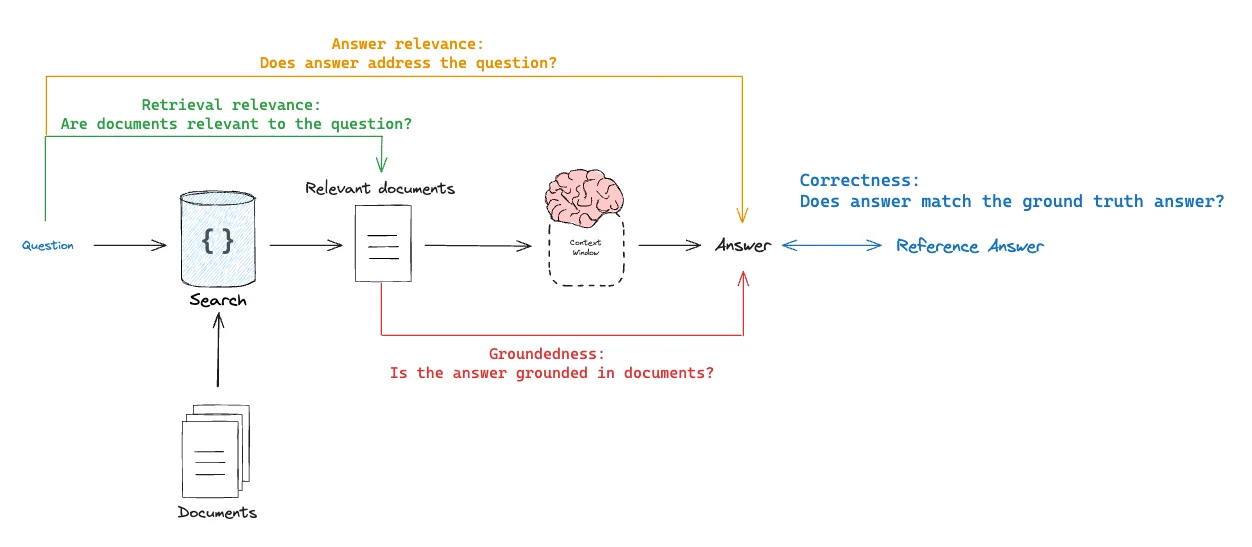
思考不同类型 RAG 评估器的一种方式是将其视为一个元组:评估对象 X 评估依据:-
正确性:响应 vs 参考答案
目标:衡量“RAG 链的答案相对于标准答案有多相似/正确”模式:需要通过数据集提供的标准(参考)答案评估器:使用 LLM 作为评判者来评估答案的正确性。
-
相关性:响应 vs 输入
目标:衡量“生成的响应在多大程度上解决了初始用户输入”模式:不需要参考答案,因为它会将答案与输入问题进行比较评估器:使用 LLM 作为评判者来评估答案的相关性、有用性等。
-
基于事实性:响应 vs 检索到的文档
目标:衡量“生成的响应在多大程度上与检索到的上下文一致”模式:不需要参考答案,因为它会将答案与检索到的上下文进行比较评估器:使用 LLM 作为评判者来评估忠实度、幻觉等。
-
检索相关性:检索到的文档 vs 输入
目标:衡量“我的检索结果对于这个查询有多相关”模式:不需要参考答案,因为它会将问题与检索到的上下文进行比较评估器:使用 LLM 作为评判者来评估相关性
正确性:响应 vs 参考答案
from typing_extensions import Annotated, TypedDict

# 评分输出模式
class CorrectnessGrade(TypedDict):
    # 注意,字段定义的顺序就是模型生成它们的顺序。
    # 将解释放在响应之前很有用,因为它迫使模型在生成最终响应之前进行思考:
    explanation: Annotated[str, ..., "解释你评分的推理过程"]
    correct: Annotated[bool, ..., "如果答案正确则为 True,否则为 False。"]

# 评分提示
correctness_instructions = """You are a teacher grading a quiz. You will be given a QUESTION, the GROUND TRUTH (correct) ANSWER, and the STUDENT ANSWER. Here is the grade criteria to follow:
(1) Grade the student answers based ONLY on their factual accuracy relative to the ground truth answer. (2) Ensure that the student answer does not contain any conflicting statements.
(3) It is OK if the student answer contains more information than the ground truth answer, as long as it is factually accurate relative to the  ground truth answer.

Correctness:
A correctness value of True means that the student's answer meets all of the criteria.
A correctness value of False means that the student's answer does not meet all of the criteria.

Explain your reasoning in a step-by-step manner to ensure your reasoning and conclusion are correct. Avoid simply stating the correct answer at the outset."""

# 评分 LLM
grader_llm = ChatOpenAI(model="gpt-5.4", temperature=0).with_structured_output(
    CorrectnessGrade, method="json_schema", strict=True
)

def correctness(inputs: dict, outputs: dict, reference_outputs: dict) -> bool:
    """用于 RAG 答案准确性的评估器"""
    answers = f"""\
QUESTION: {inputs['question']}
GROUND TRUTH ANSWER: {reference_outputs['answer']}
STUDENT ANSWER: {outputs['answer']}"""
    # 运行评估器
    grade = grader_llm.invoke([
        {"role": "system", "content": correctness_instructions},
        {"role": "user", "content": answers}
    ])
    return grade["correct"]
import type { EvaluationResult } from "langsmith/evaluation";
import { z } from "zod";

// 评分提示
const correctnessInstructions = `You are a teacher grading a quiz. You will be given a QUESTION, the GROUND TRUTH (correct) ANSWER, and the STUDENT ANSWER. Here is the grade criteria to follow:
(1) Grade the student answers based ONLY on their factual accuracy relative to the ground truth answer. (2) Ensure that the student answer does not contain any conflicting statements.
(3) It is OK if the student answer contains more information than the ground truth answer, as long as it is factually accurate relative to the  ground truth answer.

Correctness:
A correctness value of True means that the student's answer meets all of the criteria.
A correctness value of False means that the student's answer does not meet all of the criteria.

Explain your reasoning in a step-by-step manner to ensure your reasoning and conclusion are correct. Avoid simply stating the correct answer at the outset.`

const graderLLM = new ChatOpenAI({
  model: "gpt-5.4",
  temperature: 0,
}).withStructuredOutput(
  z
    .object({
      explanation: z
        .string()
        .describe("Explain your reasoning for the score"),
      correct: z
        .boolean()
        .describe("True if the answer is correct, False otherwise.")
    })
    .describe("Correctness score for reference answer v.s. generated answer.")
);

async function correctness({
  inputs,
  outputs,
  referenceOutputs,
}: {
  inputs: Record<string, any>;
  outputs: Record<string, any>;
  referenceOutputs?: Record<string, any>;
}): Promise<EvaluationResult> => {
  const answer = `QUESTION: ${inputs.question}
    GROUND TRUTH ANSWER: ${referenceOutputs.answer}
    STUDENT ANSWER: ${outputs.answer}`

  // 运行评估器
  const grade = graderLLM.invoke([{role: "system", content: correctnessInstructions}, {role: "user", content: answer}])
  return grade.score;
};
相关性:响应 vs 输入
流程与上面类似,但我们只需查看inputs 和 outputs,而不需要 reference_outputs。没有参考答案,我们无法评估准确性,但仍然可以评估相关性——即模型是否解决了用户的问题。
# 评分输出模式
class RelevanceGrade(TypedDict):
    explanation: Annotated[str, ..., "解释你评分的推理过程"]
    relevant: Annotated[
        bool, ..., "提供关于答案是否解决了问题的评分"
    ]

# 评分提示
relevance_instructions = """You are a teacher grading a quiz. You will be given a QUESTION and a STUDENT ANSWER. Here is the grade criteria to follow:
(1) Ensure the STUDENT ANSWER is concise and relevant to the QUESTION
(2) Ensure the STUDENT ANSWER helps to answer the QUESTION

Relevance:
A relevance value of True means that the student's answer meets all of the criteria.
A relevance value of False means that the student's answer does not meet all of the criteria.

Explain your reasoning in a step-by-step manner to ensure your reasoning and conclusion are correct. Avoid simply stating the correct answer at the outset."""

# 评分 LLM
relevance_llm = ChatOpenAI(model="gpt-5.4", temperature=0).with_structured_output(
    RelevanceGrade, method="json_schema", strict=True
)

# 评估器
def relevance(inputs: dict, outputs: dict) -> bool:
    """一个简单的 RAG 答案有用性评估器。"""
    answer = f"QUESTION: {inputs['question']}\nSTUDENT ANSWER: {outputs['answer']}"
    grade = relevance_llm.invoke([
        {"role": "system", "content": relevance_instructions},
        {"role": "user", "content": answer}
    ])
    return grade["relevant"]
import type { EvaluationResult } from "langsmith/evaluation";
import { z } from "zod";

// 评分提示
const relevanceInstructions = `You are a teacher grading a quiz. You will be given a QUESTION and a STUDENT ANSWER. Here is the grade criteria to follow:
(1) Ensure the STUDENT ANSWER is concise and relevant to the QUESTION
(2) Ensure the STUDENT ANSWER helps to answer the QUESTION

Relevance:
A relevance value of True means that the student's answer meets all of the criteria.
A relevance value of False means that the student's answer does not meet all of the criteria.

Explain your reasoning in a step-by-step manner to ensure your reasoning and conclusion are correct. Avoid simply stating the correct answer at the outset.`

const relevanceLLM = new ChatOpenAI({
  model: "gpt-5.4",
  temperature: 0,
}).withStructuredOutput(
  z
    .object({
      explanation: z
        .string()
        .describe("Explain your reasoning for the score"),
      relevant: z
        .boolean()
        .describe("Provide the score on whether the answer addresses the question")
    })
    .describe("Relevance score for generated answer v.s. input question.")
);

async function relevance({
  inputs,
  outputs,
}: {
  inputs: Record<string, any>;
  outputs: Record<string, any>;
}): Promise<EvaluationResult> => {
  const answer = `QUESTION: ${inputs.question}
STUDENT ANSWER: ${outputs.answer}`

  // 运行评估器
  const grade = relevanceLLM.invoke([{role: "system", content: relevanceInstructions}, {role: "user", content: answer}])
  return grade.relevant;
};
基于事实性:响应 vs 检索到的文档
另一种无需参考答案来评估响应的有用方法是检查响应是否由检索到的文档证明(或“基于”)。# 评分输出模式
class GroundedGrade(TypedDict):
explanation: Annotated[str, ..., "解释你评分的推理过程"]
grounded: Annotated[
bool, ..., "提供关于答案是否从文档中产生幻觉的评分"
]
# 评分提示
grounded_instructions = """You are a teacher grading a quiz. You will be given FACTS and a STUDENT ANSWER. Here is the grade criteria to follow:
(1) Ensure the STUDENT ANSWER is grounded in the FACTS. (2) Ensure the STUDENT ANSWER does not contain "hallucinated" information outside the scope of the FACTS.
Grounded:
A grounded value of True means that the student's answer meets all of the criteria.
A grounded value of False means that the student's answer does not meet all of the criteria.
Explain your reasoning in a step-by-step manner to ensure your reasoning and conclusion are correct. Avoid simply stating the correct answer at the outset."""
# 评分 LLM
grounded_llm = ChatOpenAI(model="gpt-5.4", temperature=0).with_structured_output(
GroundedGrade, method="json_schema", strict=True
)
# 评估器
def groundedness(inputs: dict, outputs: dict) -> bool:
"""一个简单的 RAG 答案基于事实性评估器。"""
doc_string = "\n\n".join(doc.page_content for doc in outputs["documents"])
answer = f"FACTS: {doc_string}\nSTUDENT ANSWER: {outputs['answer']}"
grade = grounded_llm.invoke([
{"role": "system", "content": grounded_instructions},
{"role": "user", "content": answer}
])
return grade["grounded"]
import type { EvaluationResult } from "langsmith/evaluation";
import { z } from "zod";

// 评分提示
const groundedInstructions = `You are a teacher grading a quiz. You will be given FACTS and a STUDENT ANSWER. Here is the grade criteria to follow:
(1) Ensure the STUDENT ANSWER is grounded in the FACTS. (2) Ensure the STUDENT ANSWER does not contain "hallucinated" information outside the scope of the FACTS.

Grounded:
A grounded value of True means that the student's answer meets all of the criteria.
A grounded value of False means that the student's answer does not meet all of the criteria.

Explain your reasoning in a step-by-step manner to ensure your reasoning and conclusion are correct. Avoid simply stating the correct answer at the outset.`

const groundedLLM = new ChatOpenAI({
  model: "gpt-5.4",
  temperature: 0,
}).withStructuredOutput(
  z
    .object({
      explanation: z
        .string()
        .describe("Explain your reasoning for the score"),
      grounded: z
        .boolean()
        .describe("Provide the score on if the answer hallucinates from the documents")
    })
    .describe("Grounded score for the answer from the retrieved documents.")
);

async function grounded({
  inputs,
  outputs,
}: {
  inputs: Record<string, any>;
  outputs: Record<string, any>;
}): Promise<EvaluationResult> => {
  const docString = outputs.documents.map((doc) => doc.pageContent).join("");
  const answer = `FACTS: ${docString}
    STUDENT ANSWER: ${outputs.answer}`

  // 运行评估器
  const grade = groundedLLM.invoke([{role: "system", content: groundedInstructions}, {role: "user", content: answer}])
  return grade.grounded;
};
检索相关性:检索到的文档 vs 输入
# 评分输出模式
class RetrievalRelevanceGrade(TypedDict):
    explanation: Annotated[str, ..., "解释你评分的推理过程"]
    relevant: Annotated[
        bool,
        ...,
        "如果检索到的文档与问题相关则为 True,否则为 False",
    ]

# 评分提示
retrieval_relevance_instructions = """You are a teacher grading a quiz. You will be given a QUESTION and a set of FACTS provided by the student. Here is the grade criteria to follow:
(1) You goal is to identify FACTS that are completely unrelated to the QUESTION
(2) If the facts contain ANY keywords or semantic meaning related to the question, consider them relevant
(3) It is OK if the facts have SOME information that is unrelated to the question as long as (2) is met

Relevance:
A relevance value of True means that the FACTS contain ANY keywords or semantic meaning related to the QUESTION and are therefore relevant.
A relevance value of False means that the FACTS are completely unrelated to the QUESTION.

Explain your reasoning in a step-by-step manner to ensure your reasoning and conclusion are correct. Avoid simply stating the correct answer at the outset."""

# 评分 LLM
retrieval_relevance_llm = ChatOpenAI(
    model="gpt-5.4", temperature=0
).with_structured_output(RetrievalRelevanceGrade, method="json_schema", strict=True)

def retrieval_relevance(inputs: dict, outputs: dict) -> bool:
    """一个文档相关性评估器"""
    doc_string = "\n\n".join(doc.page_content for doc in outputs["documents"])
    answer = f"FACTS: {doc_string}\nQUESTION: {inputs['question']}"
    # 运行评估器
    grade = retrieval_relevance_llm.invoke([
        {"role": "system", "content": retrieval_relevance_instructions},
        {"role": "user", "content": answer}
    ])
    return grade["relevant"]
import type { EvaluationResult } from "langsmith/evaluation";
import { z } from "zod";

// 评分提示
const retrievalRelevanceInstructions = `You are a teacher grading a quiz. You will be given a QUESTION and a set of FACTS provided by the student. Here is the grade criteria to follow:
(1) You goal is to identify FACTS that are completely unrelated to the QUESTION
(2) If the facts contain ANY keywords or semantic meaning related to the question, consider them relevant
(3) It is OK if the facts have SOME information that is unrelated to the question as long as (2) is met

Relevance:
A relevance value of True means that the FACTS contain ANY keywords or semantic meaning related to the QUESTION and are therefore relevant.
A relevance value of False means that the FACTS are completely unrelated to the QUESTION.

Explain your reasoning in a step-by-step manner to ensure your reasoning and conclusion are correct. Avoid simply stating the correct answer at the outset.`

const retrievalRelevanceLLM = new ChatOpenAI({
  model: "gpt-5.4",
  temperature: 0,
}).withStructuredOutput(
  z
    .object({
      explanation: z
        .string()
        .describe("Explain your reasoning for the score"),
      relevant: z
        .boolean()
        .describe("True if the retrieved documents are relevant to the question, False otherwise")
    })
    .describe("Retrieval relevance score for the retrieved documents v.s. the question.")
);

async function retrievalRelevance({
  inputs,
  outputs,
}: {
  inputs: Record<string, any>;
  outputs: Record<string, any>;
}): Promise<EvaluationResult> => {
  const docString = outputs.documents.map((doc) => doc.pageContent).join("");
  const answer = `FACTS: ${docString}
    QUESTION: ${inputs.question}`

  // 运行评估器
  const grade = retrievalRelevanceLLM.invoke([{role: "system", content: retrievalRelevanceInstructions}, {role: "user", content: answer}])
  return grade.relevant;
};
运行评估
我们现在可以使用所有不同的评估器来启动我们的评估任务。def target(inputs: dict) -> dict:
return rag_bot(inputs["question"])
experiment_results = client.evaluate(
target,
data=dataset_name,
evaluators=[correctness, groundedness, relevance, retrieval_relevance],
experiment_prefix="rag-doc-relevance",
metadata={"version": "LCEL context, gpt-4-0125-preview"},
)
# 如果安装了 pandas,可以本地将结果作为 dataframe 查看
# experiment_results.to_pandas()
import { evaluate } from "langsmith/evaluation";
const targetFunc = (inputs: Record<string, any>) => {
return ragBot(inputs.question)
};
const experimentResults = await evaluate(targetFunc, {
data: datasetName,
evaluators: [correctness, groundedness, relevance, retrievalRelevance],
experimentPrefix: "rag-doc-relevance",
metadata: {version: "LCEL context, gpt-4-0125-preview"},
});
参考代码
以下是包含上述所有代码的整合脚本:
以下是包含上述所有代码的整合脚本:
from langchain_community.document_loaders import WebBaseLoader
from langchain_core.vectorstores import InMemoryVectorStore
from langchain_openai import ChatOpenAI, OpenAIEmbeddings
from langchain_text_splitters import RecursiveCharacterTextSplitter
from langsmith import Client, traceable
from typing_extensions import Annotated, TypedDict
# 要从中加载文档的 URL 列表
urls = [
"https://lilianweng.github.io/posts/2023-06-23-agent/",
"https://lilianweng.github.io/posts/2023-03-15-prompt-engineering/",
"https://lilianweng.github.io/posts/2023-10-25-adv-attack-llm/",
]
# 从 URL 加载文档
docs = [WebBaseLoader(url).load() for url in urls]
docs_list = [item for sublist in docs for item in sublist]
# 使用指定的块大小和重叠初始化文本分割器
text_splitter = RecursiveCharacterTextSplitter.from_tiktoken_encoder(
chunk_size=250, chunk_overlap=0
)
# 将文档分割成块
doc_splits = text_splitter.split_documents(docs_list)
# 使用 OpenAIEmbeddings 将文档块添加到“向量存储”
vectorstore = InMemoryVectorStore.from_documents(
documents=doc_splits,
embedding=OpenAIEmbeddings(),
)
# 使用 langchain,我们可以轻松地将任何向量存储转换为检索组件:
retriever = vectorstore.as_retriever(k=6)
llm = ChatOpenAI(model="gpt-5.4", temperature=1)
# 添加装饰器,以便此函数在 LangSmith 中被跟踪
@traceable()
def rag_bot(question: str) -> dict:
# langchain Retriever 将被自动跟踪
docs = retriever.invoke(question)
docs_string = "".join(doc.page_content for doc in docs)
instructions = f"""You are a helpful assistant who is good at analyzing source information and answering questions.
Use the following source documents to answer the user's questions.
If you don't know the answer, just say that you don't know.
Use three sentences maximum and keep the answer concise.
Documents:
{docs_string}"""
# langchain ChatModel 将被自动跟踪
ai_msg = llm.invoke([
{"role": "system", "content": instructions},
{"role": "user", "content": question},
],
)
return {"answer": ai_msg.content, "documents": docs}
client = Client()
# 定义数据集的示例
examples = [
{
"inputs": {"question": "How does the ReAct agent use self-reflection? "},
"outputs": {"answer": "ReAct integrates reasoning and acting, performing actions - such tools like Wikipedia search API - and then observing / reasoning about the tool outputs."},
},
{
"inputs": {"question": "What are the types of biases that can arise with few-shot prompting?"},
"outputs": {"answer": "The biases that can arise with few-shot prompting include (1) Majority label bias, (2) Recency bias, and (3) Common token bias."},
},
{
"inputs": {"question": "What are five types of adversarial attacks?"},
"outputs": {"answer": "Five types of adversarial attacks are (1) Token manipulation, (2) Gradient based attack, (3) Jailbreak prompting, (4) Human red-teaming, (5) Model red-teaming."},
},
]
# 在 LangSmith 中创建数据集和示例
dataset_name = "Lilian Weng Blogs Q&A"
if not client.has_dataset(dataset_name=dataset_name):
dataset = client.create_dataset(dataset_name=dataset_name)
client.create_examples(
dataset_id=dataset.id,
examples=examples
)
# 评分输出模式
class CorrectnessGrade(TypedDict):
# 注意,字段定义的顺序就是模型生成它们的顺序。
# 将解释放在响应之前很有用,因为它迫使模型在生成最终响应之前进行思考:
explanation: Annotated[str, ..., "解释你评分的推理过程"]
correct: Annotated[bool, ..., "如果答案正确则为 True,否则为 False。"]
# 评分提示
correctness_instructions = """You are a teacher grading a quiz. You will be given a QUESTION, the GROUND TRUTH (correct) ANSWER, and the STUDENT ANSWER. Here is the grade criteria to follow:
(1) Grade the student answers based ONLY on their factual accuracy relative to the ground truth answer. (2) Ensure that the student answer does not contain any conflicting statements.
(3) It is OK if the student answer contains more information than the ground truth answer, as long as it is factually accurate relative to the ground truth answer.
Correctness:
A correctness value of True means that the student's answer meets all of the criteria.
A correctness value of False means that the student's answer does not meet all of the criteria.
Explain your reasoning in a step-by-step manner to ensure your reasoning and conclusion are correct. Avoid simply stating the correct answer at the outset."""
# 评分 LLM
grader_llm = ChatOpenAI(model="gpt-5.4", temperature=0).with_structured_output(
CorrectnessGrade, method="json_schema", strict=True
)
def correctness(inputs: dict, outputs: dict, reference_outputs: dict) -> bool:
"""用于 RAG 答案准确性的评估器"""
answers = f"""\
QUESTION: {inputs['question']}
GROUND TRUTH ANSWER: {reference_outputs['answer']}
STUDENT ANSWER: {outputs['answer']}"""
# 运行评估器
grade = grader_llm.invoke([
{"role": "system", "content": correctness_instructions},
{"role": "user", "content": answers},
]
)
return grade["correct"]
# 评分输出模式
class RelevanceGrade(TypedDict):
explanation: Annotated[str, ..., "解释你评分的推理过程"]
relevant: Annotated[
bool, ..., "提供关于答案是否解决了问题的评分"
]
# 评分提示
relevance_instructions = """You are a teacher grading a quiz. You will be given a QUESTION and a STUDENT ANSWER. Here is the grade criteria to follow:
(1) Ensure the STUDENT ANSWER is concise and relevant to the QUESTION
(2) Ensure the STUDENT ANSWER helps to answer the QUESTION
Relevance:
A relevance value of True means that the student's answer meets all of the criteria.
A relevance value of False means that the student's answer does not meet all of the criteria.
Explain your reasoning in a step-by-step manner to ensure your reasoning and conclusion are correct. Avoid simply stating the correct answer at the outset."""
# 评分 LLM
relevance_llm = ChatOpenAI(model="gpt-5.4", temperature=0).with_structured_output(
RelevanceGrade, method="json_schema", strict=True
)
# 评估器
def relevance(inputs: dict, outputs: dict) -> bool:
"""一个简单的 RAG 答案有用性评估器。"""
answer = f"QUESTION: {inputs['question']}\nSTUDENT ANSWER: {outputs['answer']}"
grade = relevance_llm.invoke([
{"role": "system", "content": relevance_instructions},
{"role": "user", "content": answer},
]
)
return grade["relevant"]
# 评分输出模式
class GroundedGrade(TypedDict):
explanation: Annotated[str, ..., "解释你评分的推理过程"]
grounded: Annotated[
bool, ..., "提供关于答案是否从文档中产生幻觉的评分"
]
# 评分提示
grounded_instructions = """You are a teacher grading a quiz. You will be given FACTS and a STUDENT ANSWER. Here is the grade criteria to follow:
(1) Ensure the STUDENT ANSWER is grounded in the FACTS. (2) Ensure the STUDENT ANSWER does not contain "hallucinated" information outside the scope of the FACTS.
Grounded:
A grounded value of True means that the student's answer meets all of the criteria.
A grounded value of False means that the student's answer does not meet all of the criteria.
Explain your reasoning in a step-by-step manner to ensure your reasoning and conclusion are correct. Avoid simply stating the correct answer at the outset."""
# 评分 LLM
grounded_llm = ChatOpenAI(model="gpt-5.4", temperature=0).with_structured_output(
GroundedGrade, method="json_schema", strict=True
)
# 评估器
def groundedness(inputs: dict, outputs: dict) -> bool:
"""一个简单的 RAG 答案基于事实性评估器。"""
doc_string = "\n\n".join(doc.page_content for doc in outputs["documents"])
answer = f"FACTS: {doc_string}\nSTUDENT ANSWER: {outputs['answer']}"
grade = grounded_llm.invoke([
{"role": "system", "content": grounded_instructions},
{"role": "user", "content": answer},
]
)
return grade["grounded"]
# 评分输出模式
class RetrievalRelevanceGrade(TypedDict):
explanation: Annotated[str, ..., "解释你评分的推理过程"]
relevant: Annotated[
bool,
...,
"如果检索到的文档与问题相关则为 True,否则为 False",
]
# 评分提示
retrieval_relevance_instructions = """You are a teacher grading a quiz. You will be given a QUESTION and a set of FACTS provided by the student. Here is the grade criteria to follow:
(1) You goal is to identify FACTS that are completely unrelated to the QUESTION
(2) If the facts contain ANY keywords or semantic meaning related to the question, consider them relevant
(3) It is OK if the facts have SOME information that is unrelated to the question as long as (2) is met
Relevance:
A relevance value of True means that the FACTS contain ANY keywords or semantic meaning related to the QUESTION and are therefore relevant.
A relevance value of False means that the FACTS are completely unrelated to the QUESTION.
Explain your reasoning in a step-by-step manner to ensure your reasoning and conclusion are correct. Avoid simply stating the correct answer at the outset."""
# 评分 LLM
retrieval_relevance_llm = ChatOpenAI(
model="gpt-5.4", temperature=0
).with_structured_output(RetrievalRelevanceGrade, method="json_schema", strict=True)
def retrieval_relevance(inputs: dict, outputs: dict) -> bool:
"""一个文档相关性评估器"""
doc_string = "\n\n".join(doc.page_content for doc in outputs["documents"])
answer = f"FACTS: {doc_string}\nQUESTION: {inputs['question']}"
# 运行评估器
grade = retrieval_relevance_llm.invoke([
{"role": "system", "content": retrieval_relevance_instructions},
{"role": "user", "content": answer},
]
)
return grade["relevant"]
def target(inputs: dict) -> dict:
    return rag_bot(inputs["question"])

experiment_results = client.evaluate(
    target,
    data=dataset_name,
    evaluators=[correctness, groundedness, relevance, retrieval_relevance],
    experiment_prefix="rag-doc-relevance",
    metadata={"version": "LCEL context, gpt-4-0125-preview"},
)

# 如果安装了 pandas,可以本地将结果作为 dataframe 查看
# experiment_results.to_pandas()
import { OpenAIEmbeddings, ChatOpenAI } from "@langchain/openai";
import { MemoryVectorStore } from "@langchain/classic/vectorstores/memory";
import { BrowserbaseLoader } from "@langchain/community/document_loaders/web/browserbase";
import { traceable } from "langsmith/traceable";
import { Client } from "langsmith";
import { evaluate, type EvaluationResult } from "langsmith/evaluation";
import { z } from "zod";

// 要从中加载文档的 URL 列表
const urls = [
    "https://lilianweng.github.io/posts/2023-06-23-agent/",
    "https://lilianweng.github.io/posts/2023-03-15-prompt-engineering/",
    "https://lilianweng.github.io/posts/2023-10-25-adv-attack-llm/",
]

const loader = new BrowserbaseLoader(urls, {
    textContent: true,
});

const docs = await loader.load();

const splitter = new RecursiveCharacterTextSplitter({
    chunkSize: 1000, chunkOverlap: 200
});

const allSplits = await splitter.splitDocuments(docs);

const embeddings = new OpenAIEmbeddings({
    model: "text-embedding-3-large"
});

const vectorStore = new MemoryVectorStore(embeddings);  // 索引分块
await vectorStore.addDocuments(allSplits)

const llm = new ChatOpenAI({
  model: "gpt-5.4",
  temperature: 1,
})

// 添加装饰器,以便此函数在 LangSmith 中被跟踪
const ragBot = traceable(
    async (question: string) => {
        // LangChain 检索器将被自动跟踪
        const retrievedDocs = await vectorStore.similaritySearch(question);
        const docsContent = retrievedDocs.map((doc) => doc.pageContent).join("");

        const instructions = `You are a helpful assistant who is good at analyzing source information and answering questions
        Use the following source documents to answer the user's questions.
        If you don't know the answer, just say that you don't know.
        Use three sentences maximum and keep the answer concise.
        Documents:
        ${docsContent}`;

        const aiMsg = await llm.invoke([
            {
                role: "system",
                content: instructions
            },
            {
                role: "user",
                content: question
            }
        ])

        return {"answer": aiMsg.content, "documents": retrievedDocs}
    }
)

const client = new Client();

// 定义数据集的示例
const examples = [
    [
        "How does the ReAct agent use self-reflection? ",
        "ReAct integrates reasoning and acting, performing actions - such tools like Wikipedia search API - and then observing / reasoning about the tool outputs.",
    ],
    [
        "What are the types of biases that can arise with few-shot prompting?",
        "The biases that can arise with few-shot prompting include (1) Majority label bias, (2) Recency bias, and (3) Common token bias.",
    ],
    [
        "What are five types of adversarial attacks?",
        "Five types of adversarial attacks are (1) Token manipulation, (2) Gradient based attack, (3) Jailbreak prompting, (4) Human red-teaming, (5) Model red-teaming.",
    ]
]

const [inputs, outputs] = examples.reduce<[Array<{ input: string }>, Array<{ outputs: string }>]>(
    ([inputs, outputs], item) => [
        [...inputs, { input: item[0] }],
        [...outputs, { outputs: item[1] }],
    ],
    [[], []]
);

const datasetName = "Lilian Weng Blogs Q&A";
const dataset = await client.createDataset(datasetName);
await client.createExamples({ inputs, outputs, datasetId: dataset.id })

// 评分提示
const correctnessInstructions = `You are a teacher grading a quiz. You will be given a QUESTION, the GROUND TRUTH (correct) ANSWER, and the STUDENT ANSWER. Here is the grade criteria to follow:
(1) Grade the student answers based ONLY on their factual accuracy relative to the ground truth answer. (2) Ensure that the student answer does not contain any conflicting statements.
(3) It is OK if the student answer contains more information than the ground truth answer, as long as it is factually accurate relative to the  ground truth answer.

Correctness:
A correctness value of True means that the student's answer meets all of the criteria.
A correctness value of False means that the student's answer does not meet all of the criteria.

Explain your reasoning in a step-by-step manner to ensure your reasoning and conclusion are correct. Avoid simply stating the correct answer at the outset.`

const graderLLM = new ChatOpenAI({
  model: "gpt-5.4",
  temperature: 0,
}).withStructuredOutput(
  z
    .object({
      explanation: z
        .string()
        .describe("Explain your reasoning for the score"),
      correct: z
        .boolean()
        .describe("True if the answer is correct, False otherwise.")
    })
    .describe("Correctness score for reference answer v.s. generated answer.")
);

async function correctness({
  inputs,
  outputs,
  referenceOutputs,
}: {
  inputs: Record<string, any>;
  outputs: Record<string, any>;
  referenceOutputs?: Record<string, any>;
}): Promise<EvaluationResult> => {
  const answer = `QUESTION: ${inputs.question}
    GROUND TRUTH ANSWER: ${referenceOutputs.answer}
    STUDENT ANSWER: ${outputs.answer}`

  // 运行评估器
  const grade = graderLLM.invoke([{role: "system", content: correctnessInstructions}, {role: "user", content: answer}])
  return grade.score;
};

// 评分提示
const relevanceInstructions = `You are a teacher grading a quiz. You will be given a QUESTION and a STUDENT ANSWER. Here is the grade criteria to follow:
(1) Ensure the STUDENT ANSWER is concise and relevant to the QUESTION
(2) Ensure the STUDENT ANSWER helps to answer the QUESTION

Relevance:
A relevance value of True means that the student's answer meets all of the criteria.
A relevance value of False means that the student's answer does not meet all of the criteria.

Explain your reasoning in a step-by-step manner to ensure your reasoning and conclusion are correct. Avoid simply stating the correct answer at the outset.`

const relevanceLLM = new ChatOpenAI({
  model: "gpt-5.4",
  temperature: 0,
}).withStructuredOutput(
  z
    .object({
      explanation: z
        .string()
        .describe("Explain your reasoning for the score"),
      relevant: z
        .boolean()
        .describe("Provide the score on whether the answer addresses the question")
    })
    .describe("Relevance score for generated answer v.s. input question.")
);

async function relevance({
  inputs,
  outputs,
}: {
  inputs: Record<string, any>;
  outputs: Record<string, any>;
}): Promise<EvaluationResult> => {
  const answer = `QUESTION: ${inputs.question}
STUDENT ANSWER: ${outputs.answer}`

  // 运行评估器
  const grade = relevanceLLM.invoke([{role: "system", content: relevanceInstructions}, {role: "user", content: answer}])
  return grade.relevant;
};

// 评分提示
const groundedInstructions = `You are a teacher grading a quiz. You will be given FACTS and a STUDENT ANSWER. Here is the grade criteria to follow:
(1) Ensure the STUDENT ANSWER is grounded in the FACTS. (2) Ensure the STUDENT ANSWER does not contain "hallucinated" information outside the scope of the FACTS.

Grounded:
A grounded value of True means that the student's answer meets all of the criteria.
A grounded value of False means that the student's answer does not meet all of the criteria.

Explain your reasoning in a step-by-step manner to ensure your reasoning and conclusion are correct. Avoid simply stating the correct answer at the outset.`

const groundedLLM = new ChatOpenAI({
  model: "gpt-5.4",
  temperature: 0,
}).withStructuredOutput(
  z
    .object({
      explanation: z
        .string()
        .describe("Explain your reasoning for the score"),
      grounded: z
        .boolean()
        .describe("Provide the score on if the answer hallucinates from the documents")
    })
    .describe("Grounded score for the answer from the retrieved documents.")
);

async function grounded({
  inputs,
  outputs,
}: {
  inputs: Record<string, any>;
  outputs: Record<string, any>;
}): Promise<EvaluationResult> => {
  const docString = outputs.documents.map((doc) => doc.pageContent).join("");
  const answer = `FACTS: ${docString}
    STUDENT ANSWER: ${outputs.answer}`

  // 运行评估器
  const grade = groundedLLM.invoke([{role: "system", content: groundedInstructions}, {role: "user", content: answer}])
  return grade.grounded;
};

// 评分提示
const retrievalRelevanceInstructions = `You are a teacher grading a quiz. You will be given a QUESTION and a set of FACTS provided by the student. Here is the grade criteria to follow:
(1) You goal is to identify FACTS that are completely unrelated to the QUESTION
(2) If the facts contain ANY keywords or semantic meaning related to the question, consider them relevant
(3) It is OK if the facts have SOME information that is unrelated to the question as long as (2) is met

Relevance:
A relevance value of True means that the FACTS contain ANY keywords or semantic meaning related to the QUESTION and are therefore relevant.
A relevance value of False means that the FACTS are completely unrelated to the QUESTION.

Explain your reasoning in a step-by-step manner to ensure your reasoning and conclusion are correct. Avoid simply stating the correct answer at the outset.`

const retrievalRelevanceLLM = new ChatOpenAI({
  model: "gpt-5.4",
  temperature: 0,
}).withStructuredOutput(
  z
    .object({
      explanation: z
        .string()
        .describe("Explain your reasoning for the score"),
      relevant: z
        .boolean()
        .describe("True if the retrieved documents are relevant to the question, False otherwise")
    })
    .describe("Retrieval relevance score for the retrieved documents v.s. the question.")
);

async function retrievalRelevance({
  inputs,
  outputs,
}: {
  inputs: Record<string, any>;
  outputs: Record<string, any>;
}): Promise<EvaluationResult> => {
  const docString = outputs.documents.map((doc) => doc.pageContent).join("");
  const answer = `FACTS: ${docString}
    QUESTION: ${inputs.question}`

  // 运行评估器
  const grade = retrievalRelevanceLLM.invoke([{role: "system", content: retrievalRelevanceInstructions}, {role: "user", content: answer}])
  return grade.relevant;
};

const targetFunc = (inputs: Record<string, any>) => {
    return ragBot(inputs.question)
};

const experimentResults = await evaluate(targetFunc, {
    data: datasetName,
    evaluators: [correctness, groundedness, relevance, retrievalRelevance],
    experimentPrefix: "rag-doc-relevance",
    metadata: {version: "LCEL context, gpt-4-0125-preview"},
});
将这些文档连接到 Claude、VSCode 等,通过 MCP 获取实时答案。